Off axis: the socket is narrower here or absent
Crown, tooth T36: University of Dundee School of Dentistry (Sketchfab: DundeeDental), CC BY 4.0, model modified.
A concept for a clinic director
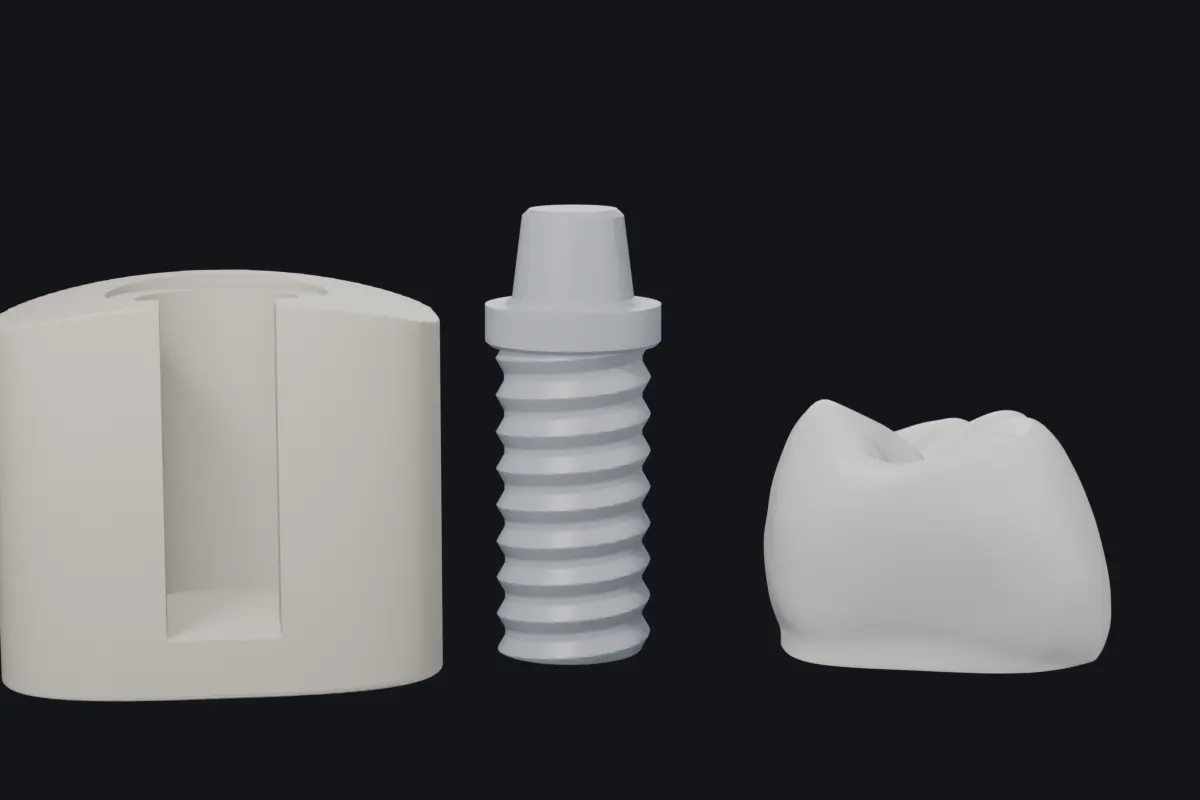
Tooth, implant and bone come apart on the table.
Nothing has physically been cast or burned. The geometry is calculated on meshes; minutes, force, burning and prices are only estimates.
Three wax parts. The cutting plane shows what is inside, and the numbers on the cut come from the calculation of these very meshes.
Show the sectionThis is not an advertisement for treatment and not a medical device. The page sells nothing and collects no data.
Three parts on the table
Bone block 92 g, implant with abutment 20.6 g, crown 54.3 g. 167 g of wax in total, 98.4 mm tall when assembled. No glue.
The anatomy here is in the crown only: a real model of tooth T36, enlarged five times. The bone and the implant are our own simplified geometry, tied to nobody's system.
The implant goes into the bone
It travels straight down and stands on its end at the bottom of the bore: 363 mm² of contact, 21 mm across.
A slot in the front of the block lets you see the fit without cutting anything.
The crown sits on the collar
239 mm² of contact, 25.8 mm outer diameter. The part stays in place by its own weight.
A press fit does not work: by calculation, paraffin creep removes it in about an hour at 22 °C. So the assembly is never lifted by the top and only travels apart. Tilt margin before it tips over is 24.8°.
The plane is in your hands
Drag across the scene or use the slider. On the axis you see the crown socket: Ø15.5→18.5 mm, 15 mm deep.
Only 8.5 mm of wax sits above the socket. It is the thinnest place in the object, and it decides whether there can be a wick.
The honest scene: the melt pool
The section shows two assumptions at once: a 6 mm pool left of the axis, a 13 mm pool right of it. That is a candle makers' rule for a different wax, not a measurement.
The rate of 6.5 g/h is an estimate too. The level is calculated from the wax mass above it; the pool's shape is schematic.
0.6 h: the 13 mm pool reaches the socket roof
With only 8.5 mm of wax above the socket, a deep pool gets to the seam almost at once.
2.5 h: the 6 mm pool is there too
Then the melt enters the gap: in a 0.1 mm gap, on the order of 0.2 s per 5 mm. Only freezing stops it.
This is an order-of-magnitude calculation; there has been no burn test.
3.4 h: the end of the wick
A wick could only be 5.5 mm long and end 3 mm above the socket roof. A stopper at its end should put the flame out before the seam.
Nobody has tested that stopper.
So the first version has no wick
The first version of this set is a display model. A crown with a wick is possible only after a burn test.
If wax runs through the seam, or the crown does not hold through an hour of burning, there is no wick and the set stays a model. The burn test itself does not close the line.
Economics: estimates only
There was no stopwatch, no batch, and nobody has tested demand. Below is a calculation from material prices and an assumed 20 % scrap rate.
- Cost per set
- 127–271 UAH
- Minimum price at a 40 % share
- 316–679 UAH
- Threshold: 40 % of 690 UAH
- 276 UAH
- Price assumption
- 690 UAH
Selected scenario: 152 UAH
- Hands39
- Box50
- Wax26
- Scrap16
- Mold wear11.5
- Wick, dye, label9.5
Tooling 360 UAH for three molds. Hands 10.6–20.5 min per set; not one minute has been measured.
The price of 690 UAH is our assumption, not data: we found no prices for gifts like this in Ukraine. The upper estimate of 271 UAH sits almost at the 276 UAH threshold.
When to close this version
The conditions are written before any showing. None of this has been tested yet, and no clinic has seen the set.
| Closing condition | Now | When to count |
|---|---|---|
| Of 30 clinics, fewer than 3 paid for 10 sets or more within 30 days at 690 UAH or more | Not counted, nothing to show yet | After 3 samples and the owner's consent to show |
| Cost above 40 % of the price, meaning above 276 UAH at 690 UAH | Estimate 127–271 UAH, close at the upper end | After 10 sets |
| More than 30 minutes of hands per set | Estimate 11–21 min | Stopwatch, 10 sets |
| More than 1 in 10 abutments breaks within 20 assemblies | Calculation: should pass | Experiment 1 |
| More than 10 % of sets do not seat, or play is visible by eye after 5 assemblies | Calculation: jams in 0–0.13 % | Experiments 1 and 4 |
| Demolding scrap above 30 % | 20 % assumed | 30 castings |
| A lawyer considers the set a toy or prohibits use of the model | Not asked | Before any sale |
The weak spot
The market is narrow and demand is unconfirmed. A clinic may not want fire, or may find such a gift strange. So this is a low-cost test of an assumption, not a bet of the whole line.
Another base part, in a glove mold, has to be cast first. Until it is and the owner reports the result, these molds are neither printed nor cast.
What is not here
- No measurements: not of breaking force, wear or burning. All of that is still ahead.
- No medical claims. The object is decorative and describes no treatment, system or clinical result.
- A "not a toy" label alone does not settle classification, so a lawyer or a lab has to be consulted before any sale.
- The hatching on the cut is schematic: all three parts are solid wax.
- No form, no orders, no prices to buy at, no dates.
How it is made
- Three real prototype meshes of 14,000 triangles each. The cut is closed through the stencil buffer, so the plane can go anywhere.
- The wax level on the cut is calculated from the volume of the same mesh. The page build fails if it diverges from the line's calculation.
- Without WebGL the page shows the outlines of the same meshes as a drawing, and the pool moves the same way.